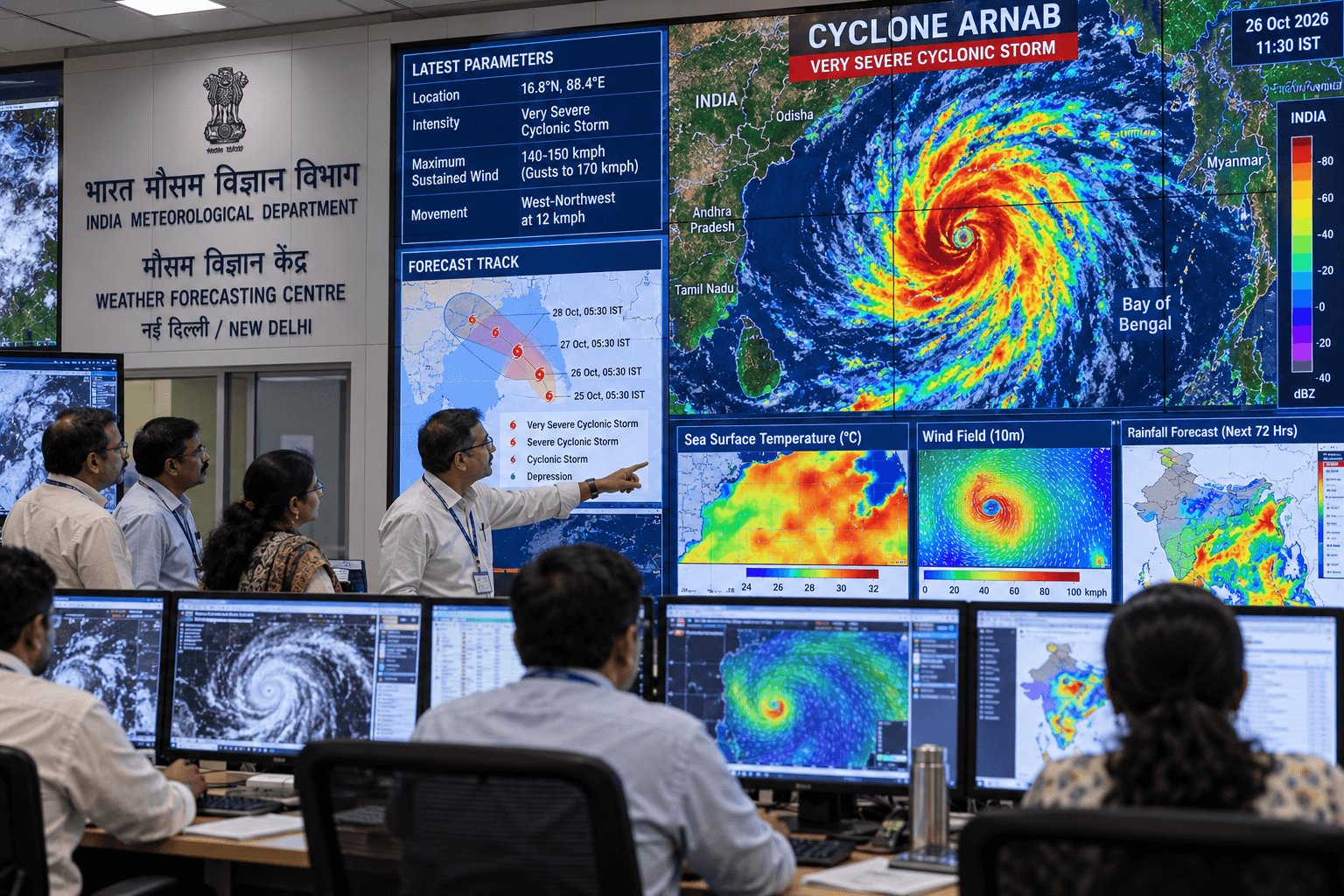
VISAKHAPATNAM — Severe Cyclonic Storm ‘Arnab’ carved a destructive path across India’s eastern seaboard on 28 October 2026, leaving at least two people dead and paralyzing regional transport networks before weakening into a deep depression over land. Coastal districts in northern Andhra Pradesh and southern Odisha absorbed the initial brunt of the system, which made landfall with sustained winds of 100 to 110 km/h, gusting up to 125 km/h. The extreme weather triggered widespread power outages, flattened standing agricultural crops, grounded commercial aviation, and forced the cancellation of more than 50 passenger trains, prompting state leadership to submit urgent appeals for emergency central disaster assistance.
The eye of Cyclone Arnab crossed the coastline during the early morning hours, delivering torrential downpours and an astronomical storm surge that breached low-lying sea walls and inundated coastal hamlets. Disaster management authorities confirmed two fatalities: one in Andhra Pradesh's Srikakulam district, caused by an uprooted banyan tree crushing a temporary dwelling, and another in Odisha's Ganjam district resulting from a structural wall collapse during peak wind gusts.
Municipal rescue squads worked through blinding squalls to clear arterial thoroughfares blocked by hundreds of fallen trees, crushed automobiles, and twisted utility poles. In Visakhapatnam and Vizianagaram, municipal drainage systems were overwhelmed by rainfall rates exceeding 45 mm per hour, submerging baseline basements, healthcare clinics, and low-lying residential layouts. Emergency teams deployed high-capacity dewatering pumps to clear access corridors to district hospitals, while State Disaster Response Force (SDRF) personnel utilized flat-bottom motorized boats to evacuate marooned families from waterlogged pockets.
Agricultural administrators reported devastating losses to rural economies. The timing of Arnab coincided directly with the maturation phase of the Kharif paddy crop. Saltwater ingress and prolonged waterlogging have submerged thousands of hectares of paddy, banana plantations, and betel-vine fields across Srikakulam, Vizianagaram, and southern Odisha's Gajapati district, raising fears of catastrophic yield losses for marginal tenant farmers.
| Impact Dimension | Verified Ground Metric / Current Operational Status |
|---|---|
| Confirmed Casualties | 2 dead (Srikakulam, Andhra Pradesh; Ganjam, Odisha) |
| Railway Disruptions | Over 50 express and passenger trains canceled across ECoR and SCR |
| Aviation Disruptions | Multiple scheduled flights diverted or grounded at Visakhapatnam and Bhubaneswar |
| Disaster Response Teams | 38 NDRF and SDRF battalions mobilized for clearing and rescue |
| Power Infrastructure Damage | Over 1,200 distribution transformers damaged; dozens of 33kV lines snapped |
| Present System Status | Weakened from Severe Cyclonic Storm to Deep Depression tracking north-northeast |
The storm inflicted severe logistical gridlock across primary transit corridors connecting eastern and southern India. The East Coast Railway (ECoR) and South Central Railway (SCR) issued emergency bulletins confirming the cancellation, short-termination, or diversion of more than 50 long-distance express and regional passenger trains operating along the vital Howrah–Chennai trunk route. Fallen high-voltage overhead traction equipment and ballast washouts between Palasa and Berhampur brought heavy freight and passenger traffic to a complete standstill for hours.
Aviation operations experienced similar disruptions. The Airports Authority of India (AAI) implemented safety protocols at Visakhapatnam International Airport and Biju Patnaik International Airport in Bhubaneswar, where strong crosswinds and localized wind shear rendered runways unsafe for commercial jet operations. Commercial carriers, including IndiGo and Air India, suspended scheduled operations for an eight-hour window, stranding hundreds of transit passengers before operations gradually resumed on a delayed schedule late Wednesday afternoon.
Along National Highway 16, which serves as the primary freight spine between Kolkata and Chennai, regional transport authorities restricted heavy commercial vehicles. Teams equipped with mechanized chain-saws and cranes worked in coordination with the National Highways Authority of India (NHAI) to remove debris, prioritizing the movement of fuel tankers and essential medical supply convoys into the worst-affected administrative blocks.
Faced with mounting infrastructure damage and displacement, Andhra Pradesh Chief Minister N. Chandrababu Naidu conducted high-level emergency review meetings in Amaravati before formally petitioning the Union Government for emergency financial support. In an official communication addressed to Union Home Minister Amit Shah, Naidu detailed the extensive damage inflicted upon coastal public utilities and demanded the immediate dispatch of an Inter-Ministerial Central Team (IMCT) to assess on-ground losses.
Naidu urged the Ministry of Home Affairs to release advance interim assistance from the National Disaster Response Fund (NDRF) to expedite rehabilitation programs and provide ex-gratia compensation to affected families.
“"Cyclone Arnab has caused widespread devastation across our northern coastal districts, destroying standing crops, shattering our rural electricity distribution networks, and washing away municipal roads. We require immediate, substantial central assistance to facilitate relief disbursements, restore power transmission, and compensate our farming communities whose livelihoods have been decimated on the eve of the harvest." — N. Chandrababu Naidu, Chief Minister of Andhra Pradesh”
Union Home Ministry officials confirmed receipt of the state's memorandum, noting that central emergency monitoring cells were actively coordinating with state relief commissioners to channel additional engineering personnel, water purification units, and satellite communication terminals to the impacted zones.
Following landfall, Cyclone Arnab began a steady process of thermodynamic dissipation as frictional drag over the landmass deprived the system of marine moisture. The India Meteorological Department’s regional cyclone warning center in Kolkata noted that while the storm’s core wind velocity had fallen significantly, its expansive convective rainbands continued to pose a threat as the system curved north-northeastward toward Gangetic West Bengal and the Bangladesh frontier.
The IMD issued targeted advisories for Kolkata, Howrah, North and South 24 Parganas, and Purba Medinipur, warning of sustained downpours accompanied by squally winds clocking between 40 and 55 km/h. Municipal authorities in Kolkata deployed specialized drainage teams across historically vulnerable traffic corridors, anticipating waterlogging during high-tide phases in the Hooghly River.
Port operations at Haldia and Kolkata docks maintained cautionary alert signals, restricting small barge movement and river ferry crossings until the remnant low-pressure system fully dissipated inland.
As storm conditions abate, administrative focus has transitioned toward the massive challenge of utility restoration and public health preservation. Over 4,000 electrical linemen from state power distribution corporations have mobilized across rural mandals to replace hundreds of damaged distribution transformers and re-string collapsed high-tension lines. Public health departments have initiated chlorinated water tanker distribution and bleaching-powder sanitation drives to prevent outbreaks of water-borne gastrointestinal illnesses in inundated relief camps.
While the rapid deployment of early warning systems and preemptive evacuations successfully prevented high loss of life, Cyclone Arnab leaves behind a long, arduous economic recovery. The coming weeks will test the efficiency of cooperative disaster federalism as state and central authorities work to rebuild damaged coastal infrastructure and provide meaningful financial relief to thousands of displaced families.